Most Muscle Cramps Are Not About Hydration. What We See Every Day as Coaches at 804 Strength in Mechanicsville, VA
Published : April 2026.
Authors: Matt Marshall (Co-Owner/ Strength Coach MSc, RSCC, CSCS, CPR/AEDD)
Collin Harrel (Co-Owner/ Strength Coach BSc, CSCS, CPR/AED)
You are mid-session. Everything feels good. Then out of nowhere, a muscle locks up, seizes, and will not let go.
If you have been there, you already know what happens next. Someone tells you to drink more water. Someone else hands you a banana. And you just stand there, waiting for the pain to stop, thinking you must have done something wrong.
You are not alone. And you probably did not do anything wrong. Here are a few comments we see all the time from people dealing with this:
“I constantly stay hydrated and it still happens, even at work. I don’t know how to get rid of them.”
“Hydrate hydrate. But honestly I don’t freaking know.”
“The worst cramps anyone can experience and the fear of continuing with exercise keeps me from working on abs.”
Sound familiar? Here is the thing: most exercise cramps have very little to do with how much water you drank. The real cause sits somewhere else entirely. And once you understand where, everything about how you train, recover, and respond when a cramp hits starts to make a lot more sense.
Key Takeaways
Exercise cramps are caused by your nervous system losing control under fatigue, not by dehydration or missing electrolytes.
(Schwellnus, 2009, British Journal of Sports Medicine)Studies show that even serious dehydration does not make you more likely to cramp when fatigue is controlled.
(Braulick et al., 2013, British Journal of Sports Medicine)Cramps happen when the “fire” signals in your muscles overwhelm the “relax” signals, and the muscle contracts on its own
The best long-term prevention is structured, progressive strength training that builds your body’s ability to handle harder work over time
Stretching can stop a cramp in the moment, but the real long-term fix is getting stronger through full range of motion, not stretching more
What a Muscle Cramp Actually Is
(and What It Is Not)
A cramp is when a muscle contracts hard, on its own, and refuses to let go. You did not tell it to fire. Your brain did not send the signal. The muscle just locked up.
It can be a quick flash of pain or a full lockdown that leaves you sore for a day or two. In extreme cases, the muscle balls up into a visible knot that you can not release no matter what you do. Some episodes last a few seconds. Others, in rare cases, have lasted over eight hours (Giuriato et al., 2018, Journal of Electromyography and Kinesiology).
People often use the words “cramp” and “spasm” like they mean the same thing. They do not. A spasm is a general term for any involuntary muscle movement — that includes small twitches, tics, and things tied to neurological conditions. A cramp is more specific. It is sudden, it hurts, and it goes away on its own eventually. When we talk about what happens mid-workout, we are talking about cramps.
Getting this right matters. If you misidentify the problem, you end up chasing the wrong fix..
"Hydrate Hydrate" — Why the Most Common
Advice Does Not Actually Work
“I constantly stay hydrated and it still happens. I don’t know how to get rid of them.”
This is one of the most common things we hear, and it makes perfect sense. You have been told your whole life that cramps mean you are dehydrated. So you drink more water, and it keeps happening anyway.
The dehydration idea has been around since the 1920s. Researchers studied miners and steel workers cramping in extreme heat, noticed they were sweating a lot, and figured the two were connected. It sounded right, so it stuck. Sports science picked it up. Marketing ran with it. “Drink more” became the default answer.
But when researchers actually tested it in a controlled setting, the results were different. In a 2013 study, subjects lost 3–5% of their body weight through dehydration and lost a significant amount of electrolytes. Their cramp susceptibility did not change at all, as long as fatigue and exercise intensity were controlled (Braulick et al., 2013, British Journal of Sports Medicine).
Four other studies on marathon runners, triathletes, and endurance athletes found no consistent link between cramps and electrolyte levels or hydration status.
Even worse, some athletes who tried to solve cramps by drinking too much plain water ended up with a condition called hyponatremia — dangerously low blood sodium that can cause confusion, nausea, seizures, and in severe cases, death (Hew-Butler et al., 2017, Frontiers in Medicine).
Let’s be clear: staying hydrated is still important for your health and your performance. But dehydration is not the reason most people cramp during a workout. If it were, the person who drank a full bottle before training would never cramp. And we all know that is not how it works.
So What Actually Causes Cramps? Your Nervous System.
“How do we fix it?”
Before we get to the fix, you need to understand what is really going on. Because once this clicks, everything about cramps starts to make sense.
Inside every working muscle, two systems are talking to your spinal cord at the same time. One system (muscle spindles) sends “keep firing” signals. The other system (Golgi tendon organs) sends “time to relax” signals. When everything is working normally, these two balance each other out. Your muscle fires when it should and relaxes when it should.
But when a muscle gets tired — really tired — that balance breaks. The “relax” signals get weaker while the “keep firing” signals stay loud. Your motor neurons (the nerves that control the muscle) start firing on their own without your brain telling them to. The muscle contracts and it can not stop . That is a cramp.
This is called the altered neuromuscular control theory, and it is the explanation with the strongest scientific support right now . In plain terms: cramps are a nervous system problem, not a water problem.
Here is a study that drives this home. In 2010, researchers found that drinking pickle juice stopped electrically induced cramps in about 85 seconds. That is way too fast for the body to absorb any fluids or replace any electrolytes. The relief came from a nerve reflex triggered in the mouth and throat that told the motor neurons to calm down. The fix was not rehydration. It was the nervous system getting the right signal.
Why Fatigue Is the Real Trigger
(And Why Cramps Hit When They Do)
“This happens when I stop training for a while, so it happened to me the other day.”
Ever notice that cramps almost always show up toward the end of a workout? Not in the first five minutes. Not during your warmup. They hit when you are already deep into the session and your body is running on fumes. That is not random.
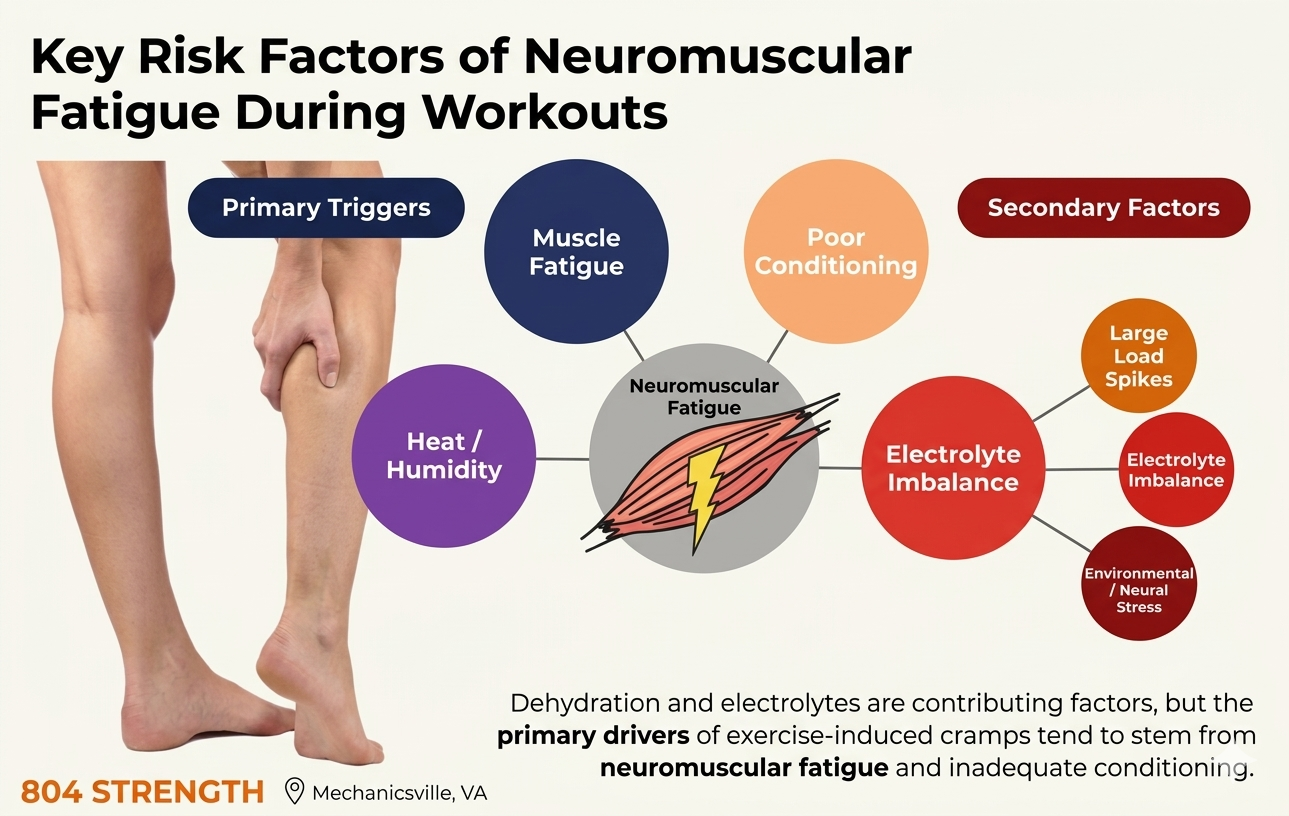
Think of your nervous system like a phone battery. At the start of a session, the battery is full. The signals controlling your muscles are running smoothly — firing when they should, relaxing when they should. But every set and every rep drains that battery a little more. At some point, the “relax” signals get too weak and the “fire” signals take over. That is when the cramp hits.
The muscle that cramps is usually the one that has been doing the most work for the longest time. Not the most dehydrated one. The most fatigued one.
A few things can drain that battery faster than normal: training in hot or humid weather, jumping up in weight or volume too quickly, skipping meals before training, and running low on the stored energy (glycogen) your muscles need. Notice that none of those are about water. They are all about how fast you push your nervous system past what it can handle.
This is also why cramps are more common when you come back after time off. Your nervous system lost some of its capacity while you were away, so even a moderate session can push you past the threshold. The comment above nails it: “This happens when I stop training for a while.” That is the neuromuscular system telling you it is not conditioned for the demand yet.
Who Cramps the Most and Why
Working with members at 804 Strength in Mechanicsville and the broader Richmond area, we see the same patterns over and over. People coming back after a break cramp more because their system has not rebuilt yet.
People who jump up in weight or volume too fast cramp because the nervous system has not had time to adapt.
Members training for endurance events like DEKA cramp more often because longer sessions mean more accumulated fatigue.
And adults over 40 tend to cramp more frequently because the nervous system’s regulatory capacity naturally narrows with age — but that does not make cramps inevitable. It just means the programming has to be smarter.
Sound familiar?
Our coaches build programs around your current capacity, not a generic template. Learn how we get started at 804 Strength
Two Cramp Beliefs Worth Dropping
“Hydrate hydrate. But honestly I don’t freaking know lol”
"Drinking more water will stop the cramping." We get it. It is the first thing everyone says. But water does not fix a nervous system problem. Controlled research shows that even serious dehydration does not make you more likely to cramp when fatigue is accounted for. Drink water because it is good for you. Just do not expect it to be the cramp solution.
"A banana before training prevents cramps." Multiple studies on endurance athletes have found no consistent link between potassium levels and cramping. A banana is a perfectly fine pre-workout snack. It is just not solving the cramp problem.
What Actually Prevents Cramps:How We Train
at 804 Strength in Mechanicsville, VA
If cramps come from the nervous system running out of capacity, then the fix is building more capacity. That means training that is structured, progressive, and consistent — not just hard.
At 804 Strength, every session is part of a bigger plan. Loads go up on purpose, not at random. Volume is managed across the week so fatigue does not spike unpredictably. And coaches adjust things in real time when someone is showing signs of fatigue. That is the advantage of a 4:1 coaching ratio — someone is watching you work, not just programming from a screen.
The practices we reinforce from day one: full range of motion training, getting stronger through end ranges, and treating sleep like part of the program. Loading a muscle through its full range under control builds the kind of resilience that passive stretching does not. A muscle that is strong at its deepest position is harder to push past its limit.
Before each session, a movement-based dynamic warmup gets the nervous system ready for what is coming. During the session, load gets adjusted based on what is actually happening, not what the spreadsheet says. For longer sessions, keeping blood glucose stable with a small carb source helps reduce the broader fatigue that drains the nervous system faster.
When a Cramp Hits Mid-Session:
What to Do Right Now
“This dr said pull your big toe back, usually goes away in 5 sec instead of the ugly 30 sec.”
There is some truth behind comments like this. Stretching a cramping muscle does work as an immediate fix — and the science backs it up. Here is the protocol:
Stop what you are doing. Apply a gentle, steady stretch to the cramping muscle and hold it for 20 to 30 seconds.
This triggers a response from the Golgi tendon organs that tells the overactive motor neurons to calm down.
For a calf cramp, pull your toes toward your shin.
For a hamstring cramp, straighten the leg and lean forward gently. Once it releases, rest before going back, and dial down the rest of your session.
But here is the important part: stretching stops the cramp in the moment. It does not prevent the next one.
The stretch fixes the immediate nerve misfire. Building the strength and capacity that keeps cramps from happening in the first place? That takes progressive training through full range of motion. Not more stretching.
Ready to Train Smarter in Mechanicsville?
A cramp is your body’s way of saying: this was more than I was ready for. The people who cramp the least are not the most hydrated ones. They are the ones whose training has gradually built up their nervous system’s ability to handle harder work without breaking down.
If you are tired of cramps interrupting your sessions and want programming that is actually built around how your body adapts, 804 Strength is worth a conversation. Every new member starts with a free consultation and a movement analysis. Sessions are coach-led, capped at four per coach, and built on a system that takes progression seriously.
Request your free trial class at 804 Strength. No credit card required.
FAQ: About Muscle Cramps During Workouts
-
Exercise cramps happen when your nervous system loses control of a muscle under fatigue. Inside every working muscle, there are signals telling it to fire and signals telling it to relax. When fatigue builds up, the “relax” signals weaken and the muscle contracts on its own. Research published in the British Journal of Sports Medicine identifies this neuromuscular breakdown as the leading explanation for exercise cramps
-
Not according to controlled research. A 2013 study dehydrated subjects by 3–5% of their body weight and found no change in cramp susceptibility when fatigue was controlled (Braulick et al., 2013, British Journal of Sports Medicine). Studies on endurance athletes found no consistent link between hydration, electrolyte levels, and cramps (Schwellnus, 2009, British Journal of Sports Medicine). Stay hydrated for your health, but water is not the cramp fix.
-
A spasm is a general term for any involuntary muscle movement, including twitches and things linked to neurological conditions. A cramp is more specific: it is a sudden, painful contraction that happens during or after exercise and goes away on its own. They have different causes and different solutions, which is why using them interchangeably leads to confusion.
-
Stop the movement and gently stretch the cramping muscle for 20–30 seconds. This activates a nerve response that tells the overactive motor neurons to stand down (Schwellnus, 2009, British Journal of Sports Medicine). Once it releases, rest before going back and reduce the remaining workload. This is an emergency response, not a long-term prevention strategy.
-
Stretching can stop a cramp that is already happening, but it does not prevent future ones. Long-term prevention comes from building strength through full range of motion with progressive, structured training. A muscle that is strong in its deepest position is harder to push past its limit than a muscle that is just flexible.
-
Because fatigue is cumulative. Each set and rep drains the nervous system’s ability to regulate the muscle. The longer the session, the weaker the “relax” signals get, and the more likely a muscle is to fire on its own.
-
Research has not found consistent evidence that low potassium causes exercise cramps in healthy athletes. Bananas are a fine snack. They are just not a cramp solution. The real prevention is progressive strength training that builds your nervous system’s capacity.
-
Yes. The nervous system’s ability to regulate muscles narrows with age, which means the gap between normal effort and a cramp gets smaller after 40. But cramps are not inevitable at any age. Smart, structured training that progressively builds capacity makes a real difference.
References
Braulick, K.W., Miller, K.C., Albrecht, J.M., Tucker, J.M., & Deal, J.E. (2013). Significant and serious dehydration does not affect skeletal muscle cramp threshold frequency. British Journal of Sports Medicine, 47(11), 710–714.
Giuriato, G., Pedrinolla, A., Schena, F., & Venturelli, M. (2018). Muscle cramps: A comparison of the two-leading hypothesis. Journal of Electromyography and Kinesiology, 41, 89–95.
Hew-Butler, T., Loi, V., Pani, A., & Rosner, M.H. (2017). Exercise-associated hyponatremia: 2017 update. Frontiers in Medicine, 4, 21.
Maughan, R.J. & Shirreffs, S.M. (2019). Muscle cramping during exercise: Causes, solutions, and questions remaining. Sports Medicine, 49(Suppl 2), 115–124.
Miller, K.C., Mack, G.W., Knight, K.L., Hopkins, J.T., Draper, D.O., Fields, P.J., & Hunter, I. (2010). Reflex inhibition of electrically induced muscle cramps in hypohydrated humans. Medicine & Science in Sports & Exercise, 42(5), 953–961.
Schwellnus, M.P. (2009). Cause of exercise associated muscle cramps (EAMC) — altered neuromuscular control, dehydration or electrolyte depletion? British Journal of Sports Medicine, 43(6), 401–408.
Schwellnus, M.P., Derman, E.W., & Noakes, T.D. (1997). Aetiology of skeletal muscle ‘cramps’ during exercise: a novel hypothesis. Journal of Sports Sciences, 15(3), 277–285.